
SEO Is Gardening: Six Months From Zero to Cited by AI
Earlier this year we bought a domain, put our product into production, and assumed the next part would take care of itself. It didn't. When an investor searched for us, they found nothing. In July, our search impressions were zero.
Six months later, here's where we are. I want to share how we got here, because most of what you read about SEO right now is either outdated or someone trying to sell you a course.
The numbers
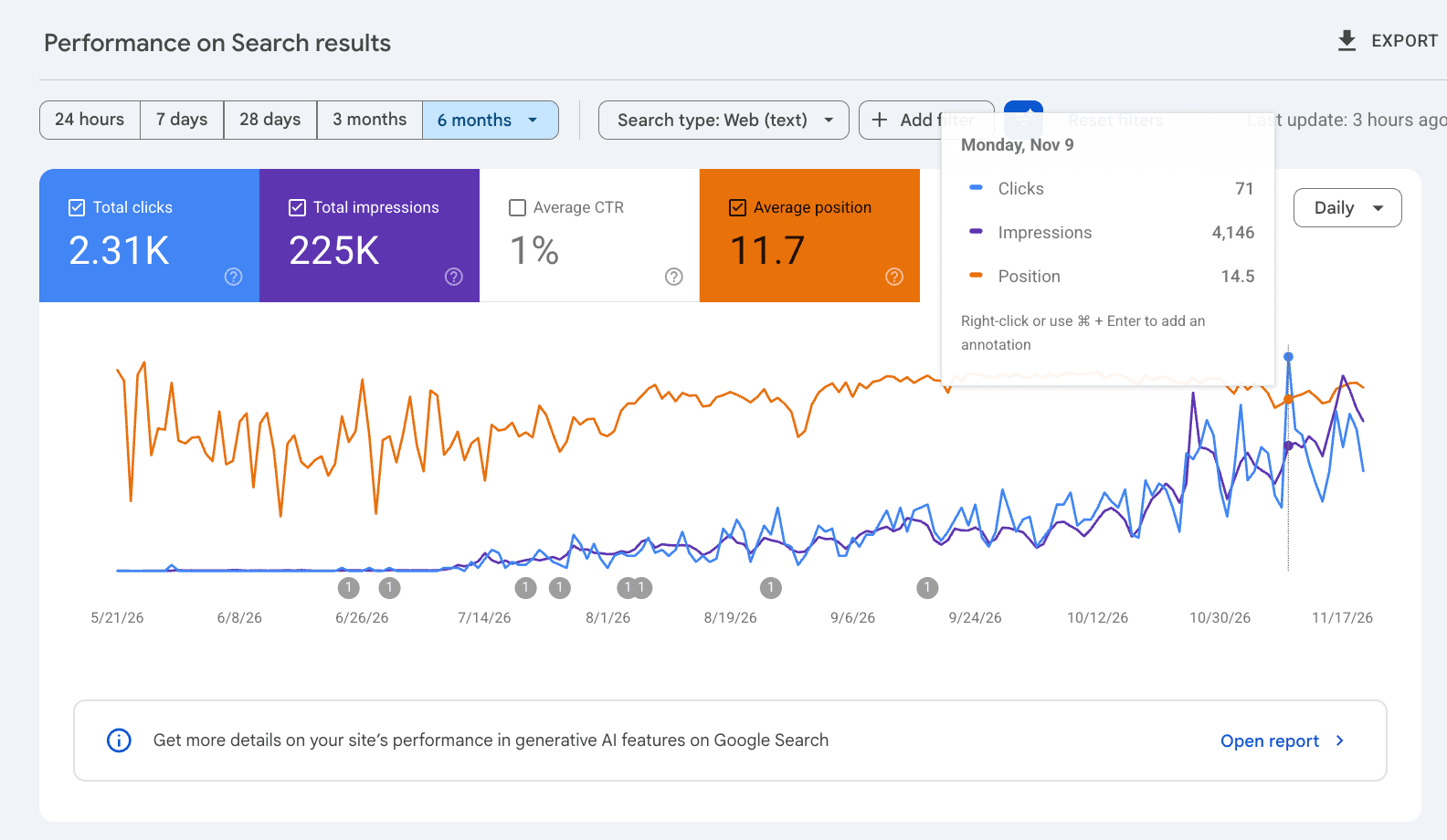
- July 5: 23 impressions, 0 clicks
- November 17: 6,474 impressions, 41 clicks
- Six-month total: 225K impressions, 2.31K clicks
Over the last 30 days, our best day brought in 71 clicks from Google alone, and our slowest brought in 23. That's before counting Bing, other engines or referrals. It's not viral, but it's steady, free and compounding, and for an early-stage company it pays for itself.
The number I find most encouraging is the one that looks worst: an average position of 11.7. Most of our rankings sit at the top of page two, which means the biggest gains are still ahead.
The three-month rule
Look at the chart again. From July to October, the line barely moves. Then, around late October, it takes off.
That shape is normal. Google itself has said for years that SEO typically takes four months to a year to show results. Our inflection came about three and a half months in, right on schedule.
If someone promises you search traffic overnight, they're doing one of two things:
- Growing a site that already has traffic and authority, or
- Lying.
New domains have to earn trust. You plant, you water, you wait. The work you do in month one shows up in month four.
Niche is an edge, not a limitation
The most underrated advantage a small company has in search is being small and specific.
Big brands compete with other big brands for big keywords. You don't have to. If you're in a corner of the internet, answering questions that only your audience is asking, you're competing with almost nobody, and Google rewards depth and polish over size.
Edward Sturm, who has run a daily SEO podcast (The Edward Show) for more than 900 consecutive days, has built a whole approach around this: rank short, high-intent pages for the exact queries buyers actually type. If you follow one person on SEO, I'd start with him. He's practical, current and allergic to fluff.
AI lowered the barrier, not the bar
Honestly, what we did this year would have taken me years to learn, plan and write on my own. With AI, it took weeks: researching the landscape, structuring content, drafting, editing and iterating.
But I want to be precise about what AI changed. It lowered the barrier to entry. It did not lower the bar.
You can spin up a niche site and farm traffic with generated content, and people do run that as a business. You also see the horror stories when it gets caught. In 2024, Google introduced a scaled content abuse policy aimed at exactly this: mass-producing pages to manipulate rankings, whether a human or an AI wrote them. The penalty can be dropping out of results entirely.
What lasts is what has always lasted: research-backed, genuinely useful content. AI made us faster at producing it. It didn't make the research optional.
A funny footnote: when we checked our backlinks, we found that one of our competitors had used AI to write a "best tools" roundup for our category, and it ranked us among the top picks. If you're reading this: thank you. 🙏
Showing up in AI answers
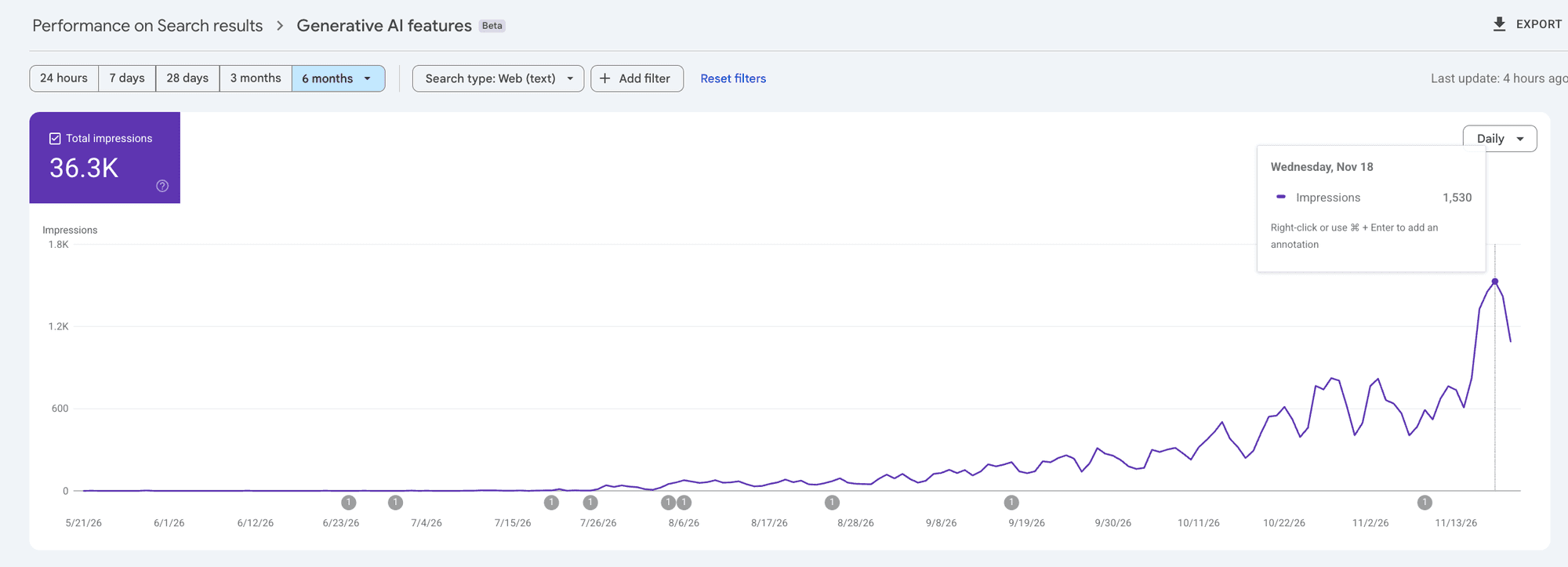
This is the chart I'm proudest of. Google's AI features (AI Overviews and AI Mode) went from showing us zero times to 1,530 times in a single day, and 36.3K times over six months.
Look closely and you can see something else: the weekends. Every week there's a dip. These aren't bots crawling us around the clock. They're real people, at work during the week, asking real questions.
That's the part of "AEO" (answer engine optimization) I think people get wrong. The industry is over-indexing on AI as if it were the audience. It isn't. Humans are still the driver. A person asks a question, and the assistant runs searches on their behalf to answer it. You're writing for both: the human's question and the follow-up searches their assistant runs.
Spend enough time in your search data and you'll start to see distinct search profiles: clusters of people asking the same underlying question in different ways. Each profile is a brief for your next piece of content.
Pollinate the AI engines
Here's one tactic I haven't seen discussed much. Ask the AI engines about your company and your category. Use Perplexity, ChatGPT, Claude, Copilot, all of them.
It helps in two ways:
- It sends their crawlers to you. When an assistant searches the web to answer your question, it fetches your pages live. You can watch it happen in your server logs. You're pollinating: putting your site in front of the systems your future customers will use.
- It's a free audit. These are enormous brains, and you get to see what they think you are. When an answer is wrong, vague or missing you entirely, that's your next page to write.
To be clear, chatting with a model doesn't directly teach it about you. Your conversation doesn't get added to what it knows. But it shows you where you're invisible, and it gets your content fetched. Eventually they'll find you on their own, but there's no reason to wait.
The Bing problem
And then there's Bing.
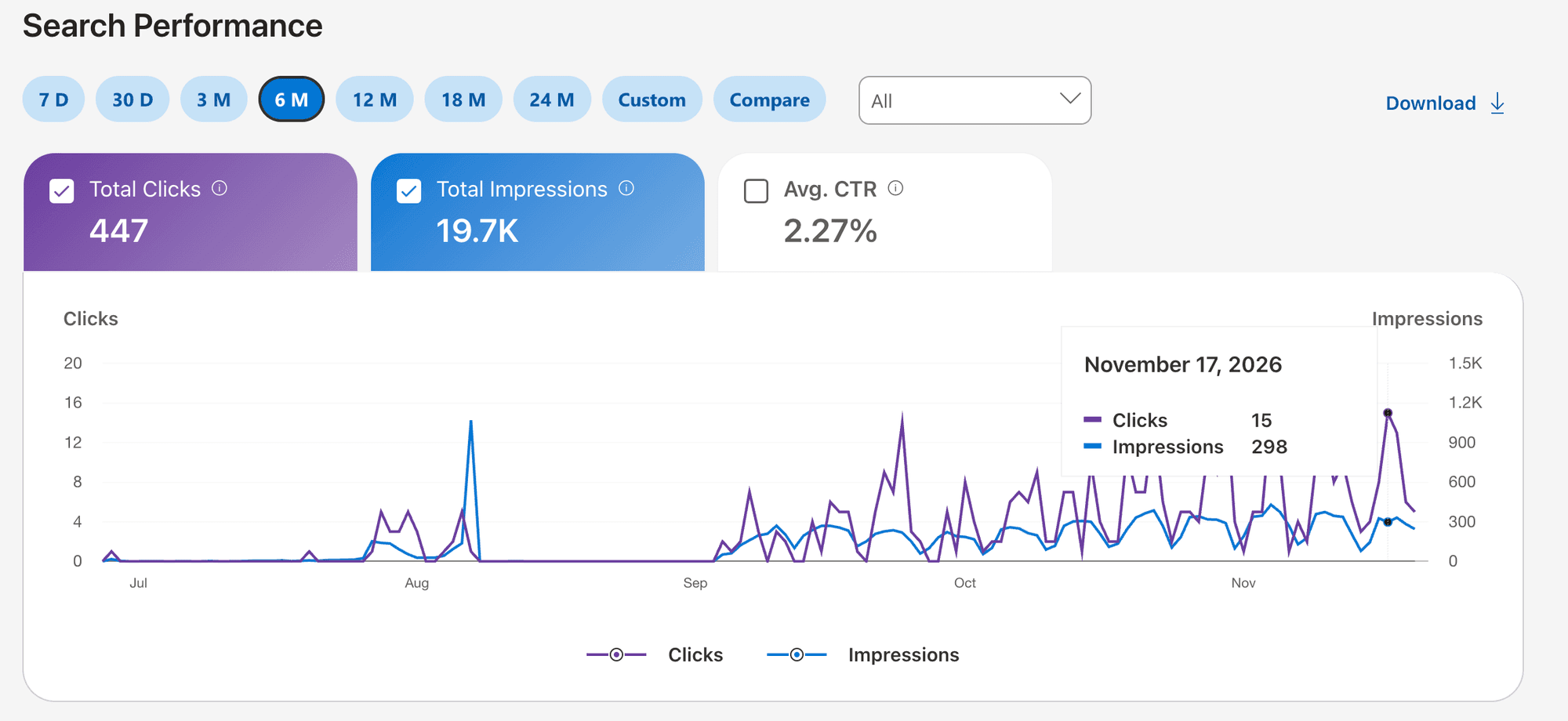
On August 7, after a round of site upgrades, we passed 1,000 daily impressions on Bing for the first time. The next day, we were delisted. Not demoted, but removed from the index entirely.
Getting back in meant human review, and it took a month of support tickets. Support's explanation, roughly, was that they wanted to see more authority before restoring our traffic, so we should get more people to link to us.
That's not bad advice in general. But it's an odd thing to tell a site that's being punished for growing. Look at the chart: in a normal world, Bing would trend the same way as Google. Instead we get two separate hills, and since reinstatement we've been visibly throttled. Either it's a policy problem, or Bing's engine genuinely struggles when a new site starts producing content quickly. I can see why so many site owners have stories like ours.
Why this matters more than Bing's market share suggests: Bing's index sits underneath a large share of AI search. ChatGPT search, Microsoft Copilot and DuckDuckGo all lean heavily on it. If Bing drops you, a whole set of AI assistants stops seeing you too.
If it happens to you, and judging by the forums it happens often:
- Set up Bing Webmaster Tools now, before you need it, so you notice when something goes wrong
- File a support ticket the same day you notice, and keep following up. Support is slow, and silence doesn't mean progress.
- Ask explicitly for a human review. Automated replies won't get you reinstated.
- Budget weeks, not days. Ours took a month.
TL;DR
- Budget at least three months. Nothing happens, then everything compounds.
- Go niche and polish everything. Corners of the internet are an edge.
- Use AI as leverage, not a replacement. Research-backed content lasts. Slop gets caught.
- Write for humans first. Their assistants are just asking follow-up questions.
- Pollinate the AI engines. Ask them about you, then fix what they get wrong.
- Watch Bing. If you get delisted, open a ticket immediately and keep pushing.
SEO in 2026 is still what it always was: an iterative process. The tools are dramatically better. The timeline isn't. Plant early, water often, and stop checking the soil every morning. 🌱