
Small Teams Are Eating the World
The most-viewed page on our site isn't about AI agents. It's a guide to choosing an all-in-one messaging app.
My job is mostly translating between AI and people.
Some days that's engineering, where AI is in everything. Other days it's investors and Wall Street, where most people have barely touched it and aren't in a rush to. The two sides have very different ideas of where software is going.
Fifteen years ago, Marc Andreessen wrote that software is eating the world. He was right. In 2024, Sam Altman put the next chapter more bluntly:
In my little group chat with my tech CEO friends there's this betting pool for the first year that there is a one-person billion-dollar company. Which would have been unimaginable without AI and now will happen.
I don't know about one person. But heading into 2027, I think the shift is bigger than software. Across work, companies and whole industries, value is moving from large organizations to small teams that can rebuild faster than incumbents can reorganize.
Small teams are eating the world. Here's what the research says, and what we're seeing in our own numbers.
What we're seeing first-hand
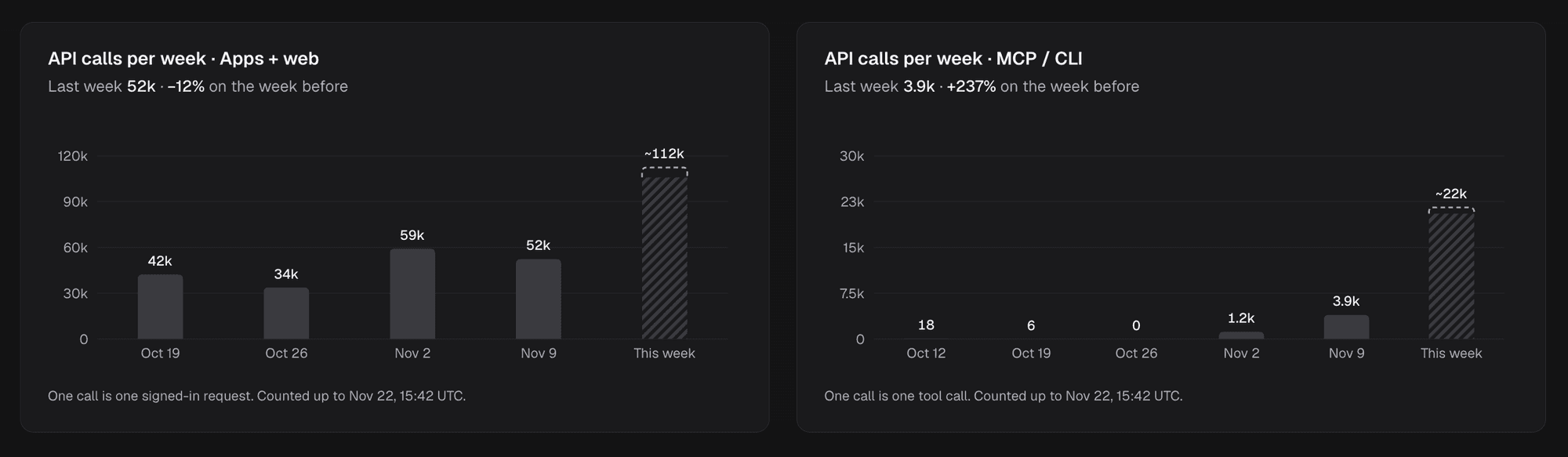
Over the last month, people using our apps and web made between 34,000 and 59,000 requests a week, and this week is on pace for more than 100,000. Agents calling our tools through MCP and the command line went from zero to roughly 22,000 calls this week.
Fun fact: our npm package only went public this week. The calls before that were early runs on our own devices. Shipping it was a real feat, and most of the effort went into developer onboarding: getting started is one command, not a multi-step gate.
People still drive most of the volume. Agents are the fastest-growing part of it, and they showed up the moment the friction went away.
1. Adoption is fast, but it's shallow
Generative AI is spreading faster than the PC or the internet did. By August 2024, nearly 40% of U.S. adults aged 18–64 had used it, according to a nationally representative survey by Bick, Blandin and Deming.
But the same study found that only about one in nine workers used it every day. Most people have tried AI. Very few have reorganized their work around it.
What this means: the gap between occasional and daily users is the real divide, and it's still early. Teams that build habits now, rather than waiting for the tools to settle, compound an advantage that's hard to catch up to.
2. Chat isn't the interface for everyone
The builder's dream is that every product collapses into a prompt. The problem is that prompting is a writing skill, and most people aren't strong writers.
UX researcher Jakob Nielsen calls this the articulation barrier. He estimates that fewer than 20% of people in high-literacy countries can write well enough to get advanced results from prompt-driven AI. It's a rough estimate, but anyone who has watched a non-technical colleague stare at an empty chat box knows the feeling.
What this means: interfaces aren't dying, they're being redesigned. The winning products will use AI under the hood and still give people structure: sensible defaults, clear views and one place to work. Most of the world runs on deals, paperwork and relationships, and those people will never open a terminal. They shouldn't have to.
3. Nobody buys a car in parts
Imagine buying a new car. The dealer hands it over, then tells you the keys are across town, you'll need to find gas yourself, and insurance is your problem. Nobody would buy that car. But it's how a lot of AI tooling is sold right now.
ChatGPT took off because it made knowledge cheap, so cheap that it became easier to copy pieces of your work and life out of a dozen different apps, paste them into one window and tell it what to do.
People turned it into the glue between their tools. That says less about chat and more about how badly people want things to work together.
I think the next wave is integrated systems, with AI built in rather than bolted on. Open source is great, and I love what the community is building. But seasoned buyers, and the generation that still runs most companies, ask the same questions every time:
- Does it work out of the box?
- Do I have to set anything up?
- Can I use it on my phone?
- Who handles security, and what happens to my data?
"It's all local" is a great answer for a hobbyist. It isn't an answer for a buyer. Buyers want managed security, a real expectation of privacy and something complete. A home build can be impressive, but it isn't a car ready for sale.
4. AI amplifies judgment; it doesn't replace it
The best evidence we have says AI is a multiplier, and multipliers depend on what they're multiplying.
- Across 5,000+ customer-support agents, an AI assistant raised productivity 14% on average and 34% for newer workers, with little gain for veterans (Brynjolfsson, Li and Raymond).
- Among 758 BCG consultants, AI users finished 12.2% more tasks, 25.1% faster on work AI handles well, but were more likely to get it wrong on a task just outside that range (Dell'Acqua et al.).
- In a randomized trial, experienced open-source developers using AI took 19% longer, while believing they were about 20% faster (METR).
What this means: the edge isn't "use AI" or "don't use AI." It's knowing where the frontier is, keeping a human in the loop where judgment matters, and measuring results instead of trusting how productive it feels. People still bring the critical thinking. AI makes it go further.
5. Small teams disrupt; large teams develop
In one of the largest studies of its kind, researchers analyzed more than 65 million papers, patents and software projects from 1954 to 2014. They found a consistent pattern: large teams tend to develop existing ideas, while small teams are far more likely to disrupt them (Wu, Wang and Evans, Nature).
There's a structural reason. Conway's law observes that organizations build systems that mirror their own structure. In a large company, the data model is the org chart, so changing one means changing the other.
Privacy is a good example. 81% of Americans say they're concerned about how companies use their data, and 61% think privacy policies are ineffective at explaining it (Pew Research Center). Fixing that for real means changing what you collect, how you store it and who can see it. For a giant, that's a multi-year migration across every product and team before a customer sees any difference. For a small team, it's a decision and a few focused weeks.
What this means: AI makes this asymmetry sharper. A small team with clear direction can now ship what used to need a department, and it can rebuild its foundations whenever customers deserve better.
6. Lived it, not studied it
The forward deployed model, pioneered by Palantir and now adopted by the major AI labs, is one of the smartest go-to-market ideas of the last decade. Embed engineers with customers, learn the problem up close, build from there. I have a lot of respect for it.
But there's a difference between studying a problem and having lived it. A forward deployed engineer is paid to learn. The strongest small teams already went through the pain themselves, before AI made anything easier, and are building the tool they wished they'd had.
That understanding is hard to hire for, and it doesn't rotate out after an engagement. We're here for the long term.
Building for both
People and agents both drift toward whatever is easiest to use. Our own numbers say people are still driving, and agents are catching up fast.
The teams that win this cycle will build for both: clear interfaces for people, one-line access for agents. They won't be the biggest. They'll be the ones who understand the work best and can rebuild the fastest.
Eric Schmidt put it simply: if you want to make money, build an agent that does something. We think we're on our way to building one, a relational agent, and it looks very different from anything we've seen on the market.
This is f*cking insane. Former Google CEO Eric Schmidt just told everyone the easiest way to get rich in the next two years:
— Ansh Bhatnagar (@iansh04_) November 21, 2026
“If you really want to make money, it’s actually easy. Found an agentic AI company. Build an agent to do something.
If you build a better agent than… pic.twitter.com/gi8WAwnBW9